Preliminary Declaration of the Electoral Transparency Foundation’s Observation Mission for Colombia’s Presidential Runoff 2026
Bogotá, June 21st, 2026
The Electoral Transparency Foundation deployed an International Election Observation Mission to monitor the Presidential Runoff in the Republic of Colombia, held on Sunday, June 21st, 2026. Citizens were called to vote between the tickets of Abelardo de la Espriella and José Manuel Restrepo, representing the Defenders of the Homeland Movement (Defensores de la Patria), and Iván Cepeda and Aída Quilcué, representing the Historical Pact (Pacto Histórico).
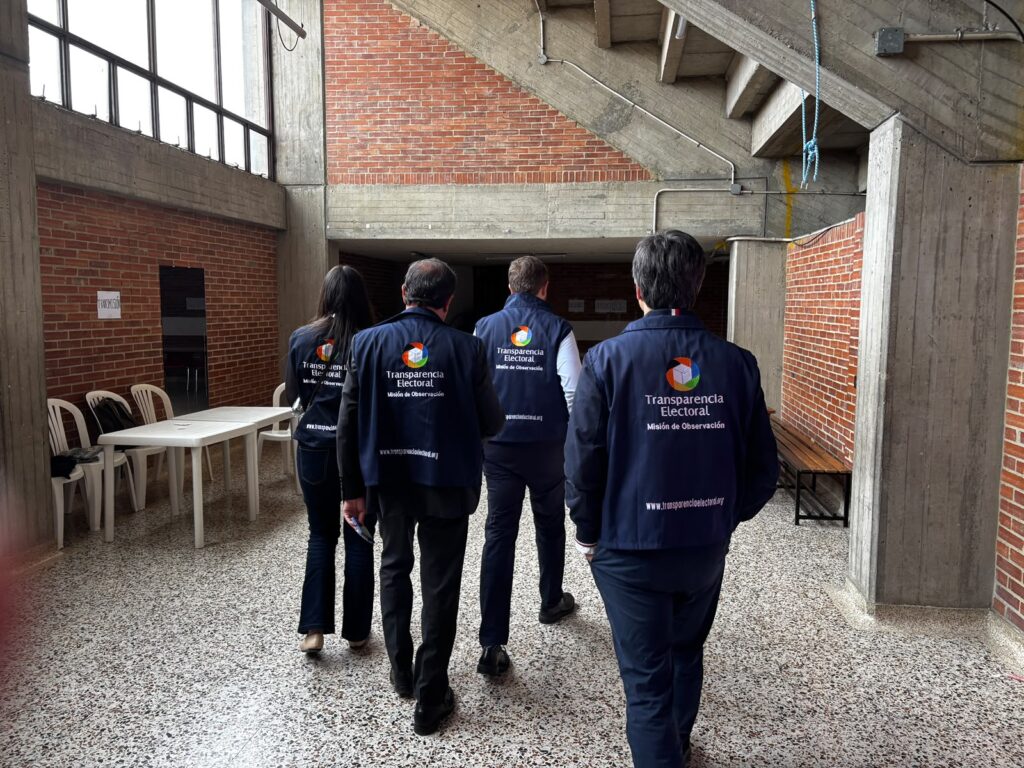
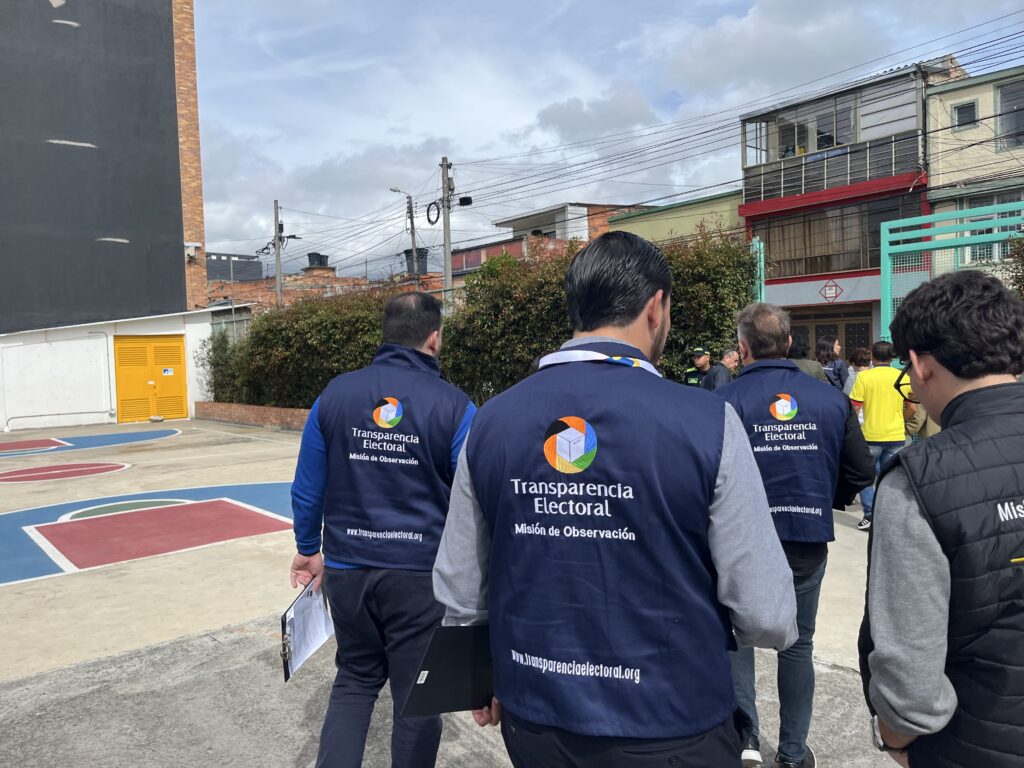
The Mission consisted of sixty (60) observers, led by Francisco Guerrero, former Secretary for Democratic Strengthening of the Organization of American States (OAS). Forty observers were deployed in Bogotá, where they monitored the voting process at various polling stations throughout the capital, while an additional twenty observers tracked the vote of Colombians residing abroad in Argentina, Brazil, Ecuador, Mexico, the United States, and Spain.
Polling stations across the country opened at 8:00 a.m. The polls closed at 4:00 p.m., with 118,346 voting tables set up across 13,489 polling stations. The National Civil Registry registered more than 41 million citizens to vote, of whom 1,414,661 were Colombians residing abroad, distributed across 253 polling stations in various countries.
The day began with the traditional opening ceremony in Bogotá’s Plaza de Bolívar at 7:00 a.m., attended by President Gustavo Petro, as well as representatives from the National Electoral Council, the National Civil Registry, the Attorney General’s Office, and accredited national and international observer missions. In his address, President Petro called on citizens to vote “overcoming any obstacle or geographical or logistical difficulty” and appealed for calm and respect throughout the day, stating that “the indispensable foundation of democracy is peace.”

During the voting process, electoral authorities reported that polling stations were properly set up across most of the country. The Director of Electoral Management at the National Registry had indicated the previous day that there were no issues with the installation of polling stations. The Colombian Association of Capital Cities reported that thirty-one of the thirty-two capital cities reported normal conditions at the time of opening, with the exception of Mitú, where a failure in the electrical interconnection line, associated with heavy rains, winds, and lightning strikes, temporarily affected service, which was restored using backup generators.
In terms of institutional presence, the Ombudsman’s Office deployed 2,342 staff members to monitor 2,126 polling stations in 408 municipalities across the country. The National Registry also reported the accreditation of more than 16,000 national and international election observers for this second round, as well as extensive coverage by poll watchers for both campaigns. The Deputy Head of the European Union Election Observation Mission highlighted the large number of poll watchers accredited by the authorities.
The security operation was led by the Ministry of National Defense, under the Democracy Plan, with the deployment of 408,000 members of the Armed Forces and the National Police throughout the country. Of these, 248,000 performed direct election security duties, and 160,000 acted as a support and response force. The national government established a Unified Command Post to continuously monitor the election day and ordered the closure of land and river border crossings from Saturday, June 20, to Monday, June 22, as well as restrictions on the sale of alcoholic beverages in various cities across the country.
Among the incidents reported during the day, authorities reported an accident involving a boat transporting election materials in the rural area of San Jacinto del Cauca. The accident occurred in the early morning hours and affected approximately four hundred ballots from three villages in the municipality. The materials were later replaced through coordination between the National Navy and the National Registry. Additionally, reports of alleged vote buying were filed in the department of La Guajira, and two arrests were made in the departments of Cesar and Guainía for election-related offenses. Furthermore, a shooting attack was reported against three election observers from Abelardo de la Espriella’s campaign, for which the National Police issued a report.
Regarding weather conditions, the Institute of Hydrology, Meteorology and Environmental Studies (IDEAM) had anticipated cloudy skies and dry conditions during the morning, with an increased probability of rain in the afternoon across much of the country, particularly in the Caribbean, Pacific, Andean, and Eastern Plains regions. In the 24 hours leading up to the elections, two minor emergencies were reported: a forest fire, now under control, in the municipality of Pacho (Cundinamarca), and a rain-related event in the municipality of Páez (Boyacá), which remained under monitoring by authorities.
Regarding the technical transparency of the process, the National Registry reported that on Saturday, June 20, with verification from the Attorney General’s Office, the security hash code of the vote-counting software installed at the counting commissions in Antioquia, Atlántico, Magdalena, Risaralda, Santander, Valle del Cauca, and Bogotá was validated. This validation confirmed that it corresponded to the same source code that had been audited and frozen prior to election day. However, President Petro publicly reiterated, both before and during election day, his reservations about the vote-counting process, stating that he would not recognize the results of the afternoon’s preliminary count and would only accept the results of the official legal count, conducted by the judges of the Republic in the following days.
Attorney General Gregorio Eljach issued a statement of reassurance hours before the opening of the polls and highlighted the results of the institutional Electoral Peace strategy, implemented jointly with the Comptroller General’s Office, the National Registry, and various social sectors. For his part, the president of the National Electoral Council, Cristian Quiroz, called on citizens to vote peacefully and reiterated the electoral institutions’ commitment to a transparent count of every vote. Interior Minister Armando Benedetti reported that all thirty-two departments of the country remained connected to report any developments throughout the day, while Defense Minister Pedro Sánchez emphasized the neutrality and impartiality of the security forces in the process and reiterated that the final results correspond to the official count, not the preliminary count.
Through its proprietary reporting application, «Civic Radar,» used by observers deployed in Bogotá as well as those monitoring voting abroad, the Electoral Transparency Foundation’s Mission received information from a sample of 215 polling stations. At the time of closing, the Mission was not aware of any systematic irregularities or incidents that compromised the overall integrity of the process at the observed polling stations. The incidents reported during the day were isolated and localized, typical of an electoral process of this magnitude, and were promptly addressed by the relevant authorities.
According to data collected by observers, 96% of polling stations had signage and information available regarding the identification documents required to vote, the voter registration list, and the procedures for opening and counting ballots.
The Electoral Transparency Foundation commends the commitment of Colombian institutions to national and international election observation, as well as the civic-mindedness of the citizens who went to the polls despite adverse weather conditions in various regions of the country and in a context of high political polarization. The Mission also acknowledges the work carried out by the National Registry, the National Electoral Council, the Office of the Attorney General, the Office of the Ombudsman, the Ministry of Defense, and the Public Forces to ensure the orderly conduct of the election day.
At the same time, the Electoral Transparency Foundation notes the persistent questioning of electoral institutions by the head of state, expressed repeatedly in the days leading up to and during election day, despite the technical guarantees offered by the National Registrar Recorder’s Office and verified by the Office of the Attorney General.
Narratives of fraud that lack concrete evidence and solid proof pose a risk to public trust in democratic institutions and to the peaceful acceptance of the results by all political actors. All actors must act with democratic responsibility to create a suitable environment for the electoral process.
The Electoral Transparency Foundation calls on all political, institutional, and social actors to prioritize respect for the legal procedures of the vote count and to avoid demonstrations that could jeopardize the peaceful coexistence in the country during the election.